This Is Not Water

Does it matter when a game says something doesn't matter?
This week in my "Video Games and Language" class, we read from Pippin Barr's The Stuff Games are Made Of (available open-access!). It's an excellent book and one of my favorites to teach, not just because of its approachable insights into the functional, material elements of game design—the relationship between code and bits, or the moods and affordances of interfaces—but because its examples, the object lessons Barr makes out of his own design works and processes, strike a balance between whimsy and irony that's ideal for classroom discussions.
I always like to have an instance of Let's Play: Ancient Greek Punishment: CPU Edition running on the projector when I teach the book. It's a variation of Barr's earlier game of the same name, sans final subtitle, which transforms the eternal torture of mythological figures into cute little mini-games, played, in this case, entirely and effectively eternally by the computer. As Sisyphus behind me ceaselessly rolls his boulder up the impossible incline, incrementing an integer one step at a time, I always feel idle as the computer does the work.
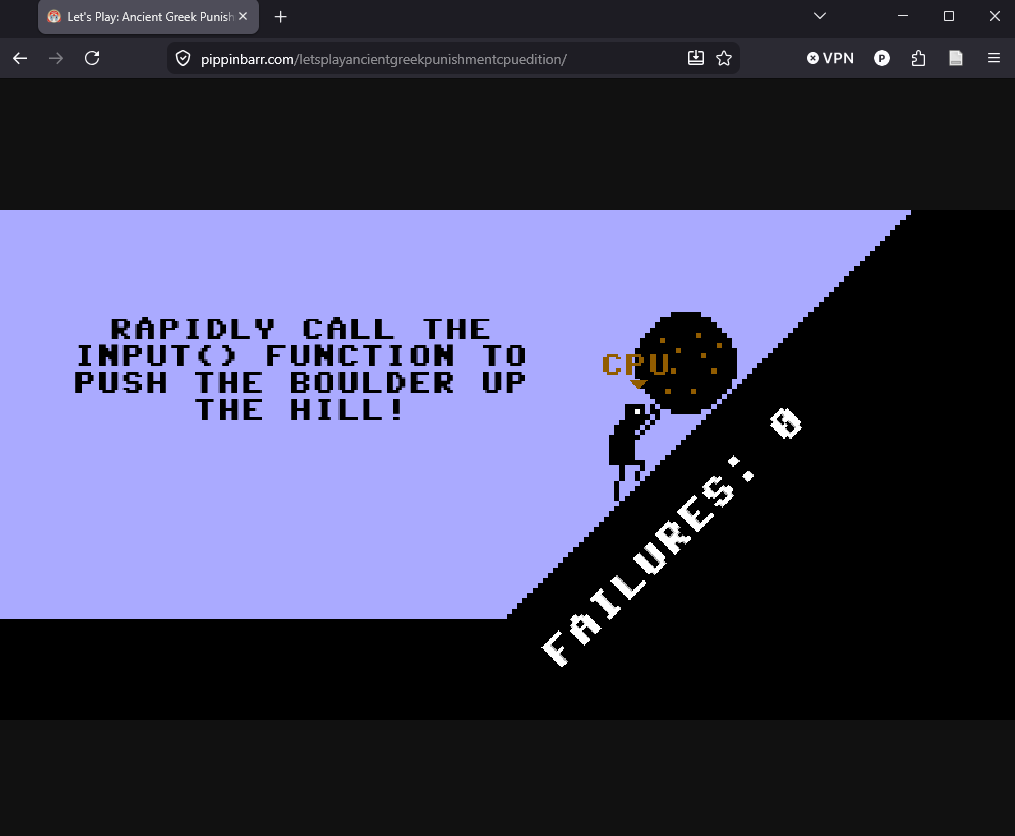
But I'm not, idle, really. And neither are my students. We talk about Sisyphus and his quixotic trial. We reference him. Point to his growing tally of failed attempts. We're all doing a a kind of work—mental, philosophical—even if it's not the work of moving the character.
(This time, midway through class, I had the idea to dramatically reveal, the next time I teach this lesson, that Sisyphus' projected progress is actually a screen recording I will have prepared in advance: highlighting and defeating precisely the point Barr tries to make about the computer "actually" doing the work it depicts, now transforming it into a different work, albeit similar in kind, to re-present work already completed.)
Another way of framing CPU Sisyphus' situation, invited by Barr's own conception, is to say that, as far as this experiment is concerned, the activity of the player simply doesn't matter very much to the game that's being played. Or maybe, in that we play the game, we do so given a rule—yoked, that is, to a mechanic—that bars us from taking any intentional action beyond QUIT and RESET.
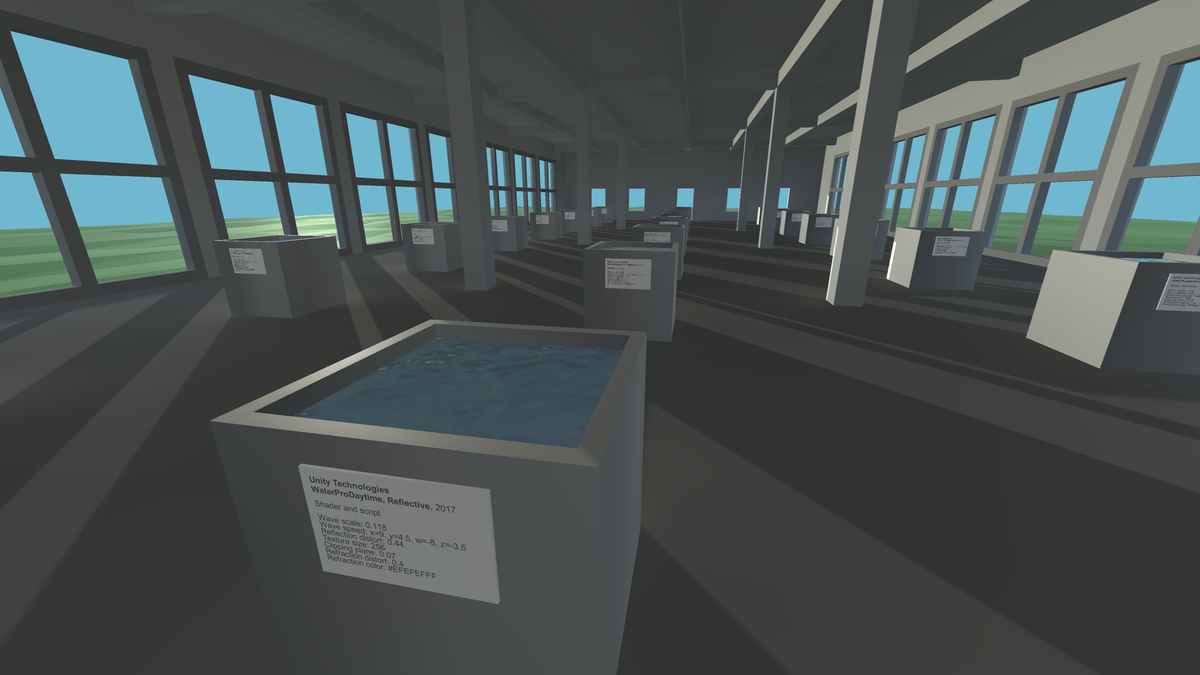
What really got me thinking about this question of what "matters" to a game, though, comes from the third chapter of Barr's book, where he writes about v r 3, an exploratory game of his built to resemble an art installation where varieties of water simulations are displayed like sculptures for a meandering observer. The simulations run the gamut from native Unity engine features to high-end plugins, each with its own prefigured argument for the sweet spot between verisimilitude and performance impact.
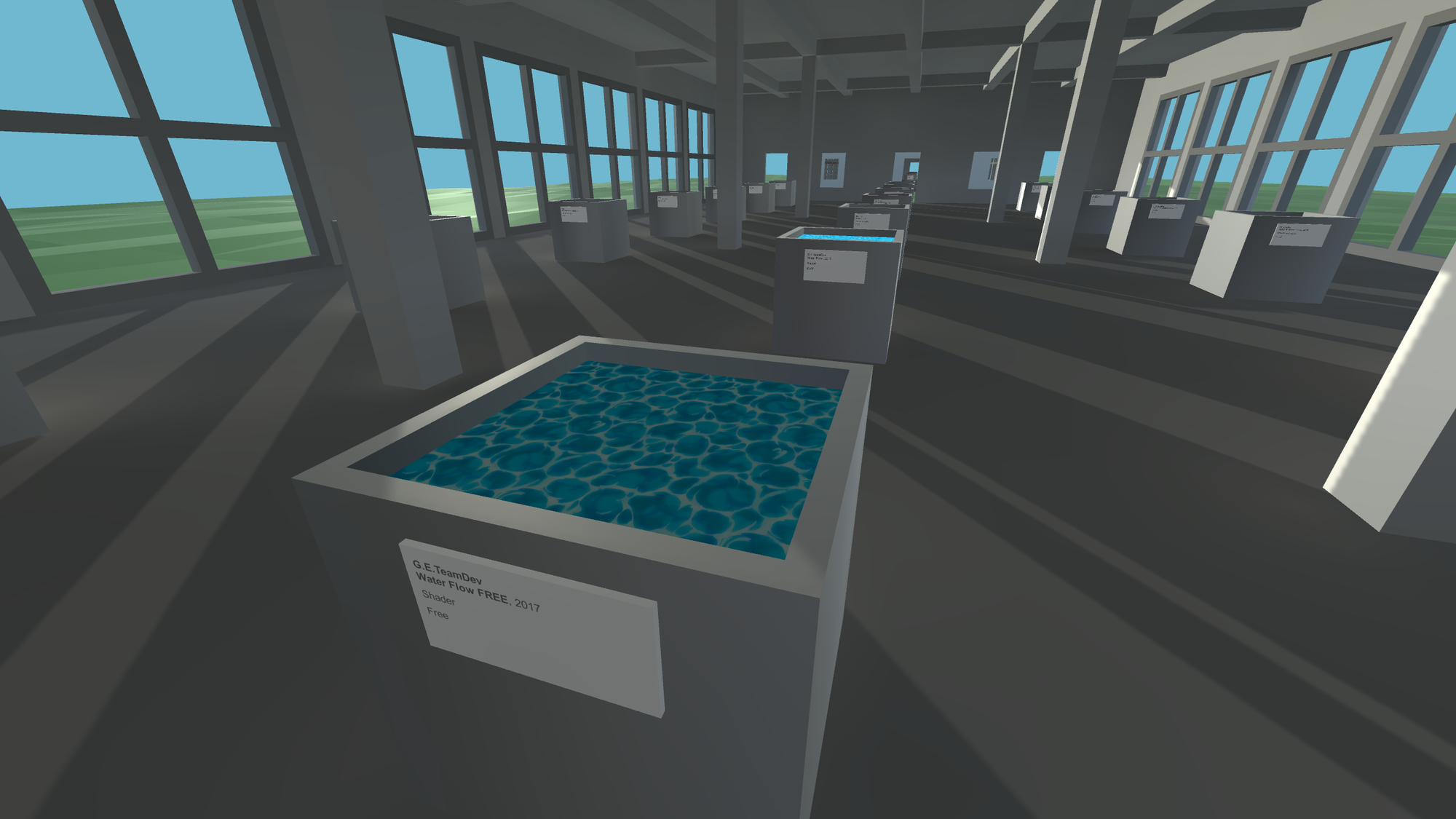
I'm not sure if water suggested itself to Barr for the number of marketplace solutions it afforded him, or if it was purely for aesthetic reasons, but thinking through the chapter in 2026 (three years after the book's publication) I couldn't help but think of his choice of water as a certain kind of cultural, and indeed political, provocation. A live wire, a lightning rod, a conductor.
I'm partly to blame for this, but my YouTube algorithm often serves me compilation videos comparing the worldly, "immersive" details of one game to another. These tend to highlight a recent title that's already become a punching bag or critical flashpoint, in contrast to an older title that's now regarded as a classic or high water mark for its genre.
The videos compare things like environmental destruction—do bullet impacts appear on surfaces, or better yet crack stone facades on walls à la The Matrix, shatter glass, or punch through wood?—or naturalistic animations for things like taking the stairs or falling from a great height. Will enemies follow the player through doors? What buildings are you allowed or disallowed from entering?

There's a cottage industry for this kind of thing—somewhat inseperable from the "ragebait" enterprise—and the implicit argument behind much of it seems to be that today's "lazy devs" can't be bothered to construct worlds as naturalistic and "immersive" as those from an imagined golden era, largely (so say, not all, but at least some vocal adherents of this logic) because they're too busy adding "injecting" things like "representation" and "politics" into their games: "going broke" what with all the "going woke" they're doing. I'm painting in broad strokes, but dig through YouTube comments or Reddit threads and you'll see the sentiment sooner than later.
All of which takes us the long way round to my original point. What just so happens to be one of the go-to examples for a game's technical, artistic, or ethical failure as defined by this mode of criticism? That's right, water. From Spider-Man's reflections to swimming in Starfield, what a player can and can't do to, in, around—pick your preferred preposition—or under water is a big deal for lots of people! But why?
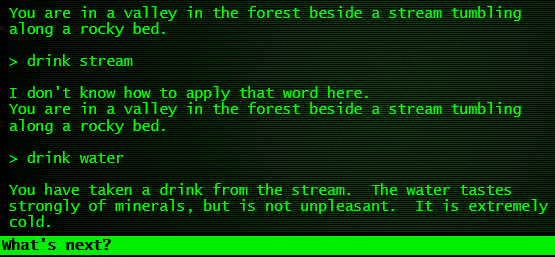
I proposed, off the cuff, in my class, that it might have something to do with the frustration my students experienced playing the text adventure games I recently assigned: a kind of disappointment resulting from a breakdown of the fantasy of infinite possibility that games from Colossal Cave Adventure (1976) to Grand Theft Auto VI (forthcoming 2026?) have largely been understood as promising.
Me, I love the "immersive sim" genre, whose hallmarks, beyond open-ended level design and stealth mechanics, include things like throwing random objects at strangers and flushing toilets, purely for the sake of making spaces seem physical and lively. On the other hand, when I see complaints about, say, the new Mafia game having less realistic water interactions than its predecessors, I just cannot bring myself to care.
Like in the case of my input for Barr's Sisyphus, what it comes down to is a question of what matters to the thing the game is trying to do. Maybe, in a radically experimental game, I the player don't matter. But maybe, for a more ordinary scenario, it's this body of water over here that doesn't.
Looking broadly at the situation, you start to see that a significant, or at least vocal, subset of players—bracketing for a moment the political implications of their professed nostalgia—simply has no patience for a game that communicates to them that something they think should matter, for it's purposes, doesn't. Moreover, they think it's always a failure, and never a choice.
Of course, it's perfectly appropriate to critique a work of art for not doing something it seems to suggest it would do. How many times have I myself been frustrated by a movie or television show for refusing to reconcile some awkward or contradictory element of its its story or themes? (Consider Star Wars long ago backing itself into a corner on the question of droid personhood.)
Far less tenable, though, are arguments that come from a desire for the thing in front of you to just be a different thing entirely. "I wish this game had swimming." "I wish this novel were in first-person." "I wish this movie were a television show." What those come from is a refusal to engage with art in the first place, to meet it on its own terms before thinking through its successes and failures.
We live with countless constraints in any kind of video game play: from necessarily resolving conflict with violence to being unable to enter an area without first triggering an arbitrary cutscene. Is it so hard to imagine that a game might be saying, "Hey, your character's not really the type of guy to go swimming for fun right now. Or, yeah, he's also not the sort who would shoot into a crowd for the hell of it."
Understandably, we think of video games differently than we think of novels, movies, and plays—but could you imagine being frustrated that an actor onstage never showed us what was on the other side of the door that's clearly part of a set? What if there was something cool in the broom closet!
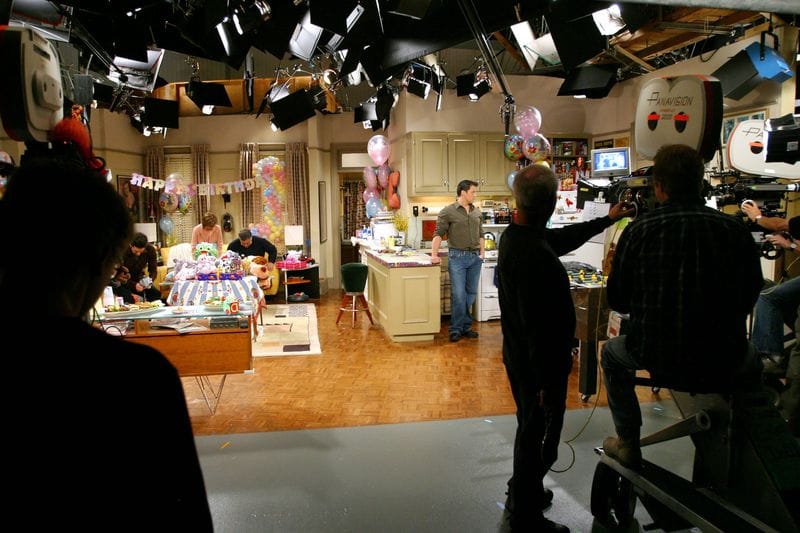
(Here I'd be remiss if I didn't mention that Slavoj Žižek has occasionally used the example of the inaccessible interior of a video game house to explain "ontological incompleteness.")
What a game does or doesn't react to tells us something. And where reactivity is concerned, as many of Barr's experiments demonstrate, more isn't always better, and it's certainly not more interesting. There's an insight here to be used toward a critique of the bizarrely solipsistic world of large language model interactions, which, meaningfully or not, will always respond to you, you sweet, special thing—but I'll save it for another day.
Highlighting variations on water—as ordinary as anything in or out of games—Barr hits on an intriguing and, in a certain context, politically incisive statement: what is simulated in a game's world, and when it matters, is always an intentional choice. So, too, when something isn't simulated, or doesn't matter.
Stephen King gives the advice in On Writing, that oftentimes a writer's first instincts for description are best. Overthinking how to describe a landscape or a building or a person or their clothes leads to overwriting. Did we really need a whole paragraph about the pattern on that fella's tie?
Swimming, or detailed reflections, or little splashes in water you have next to no reason for entering? Sometimes that's just overdesign.
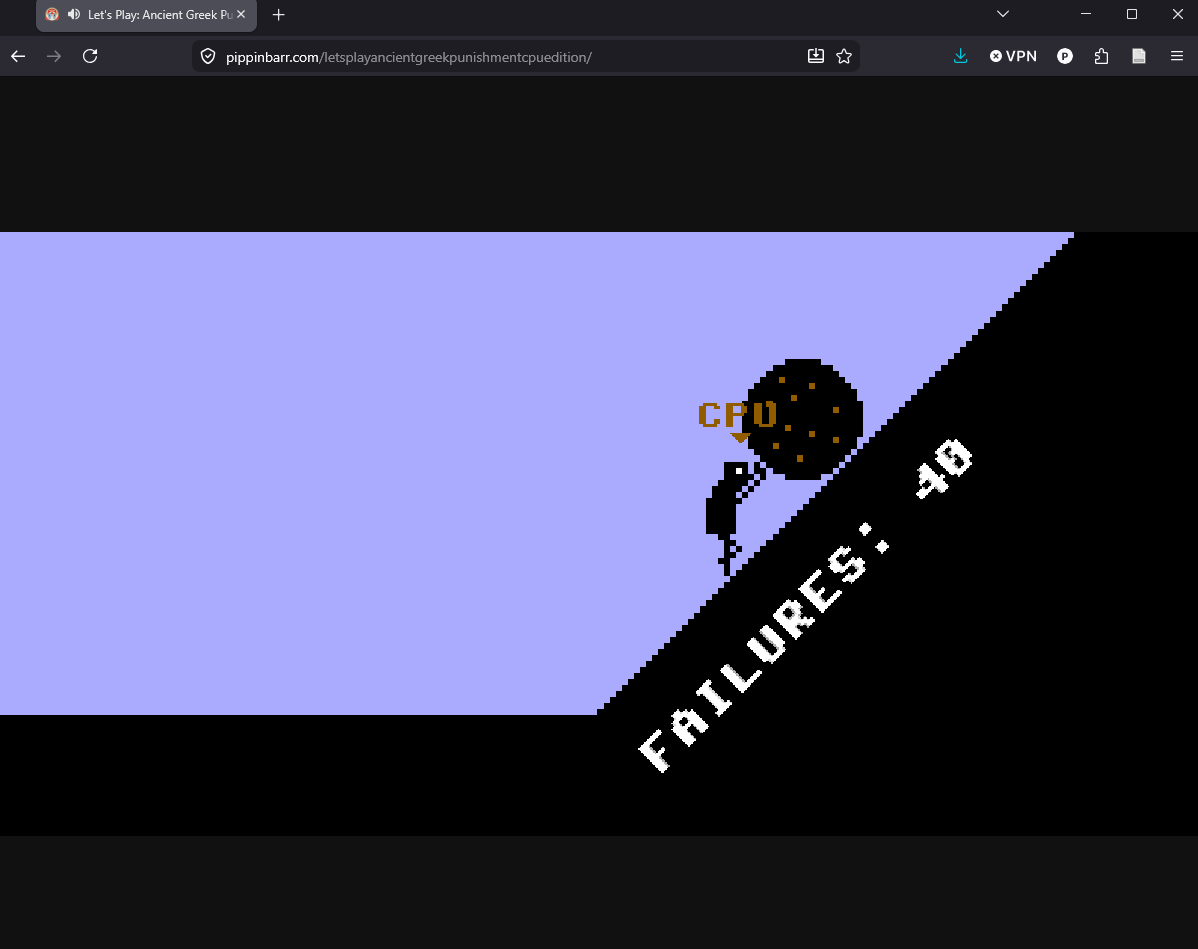
Is it so hard to imagine that non-interactive water is in a game simply to look nice? For mood, for atmosphere. To afford appreciation that has nothing to do with what it can do for you or in response to you. To move you along to the other stuff the game is way more interested in showing you. Take Sisyphus over there—he's doing fine without you!
POF